
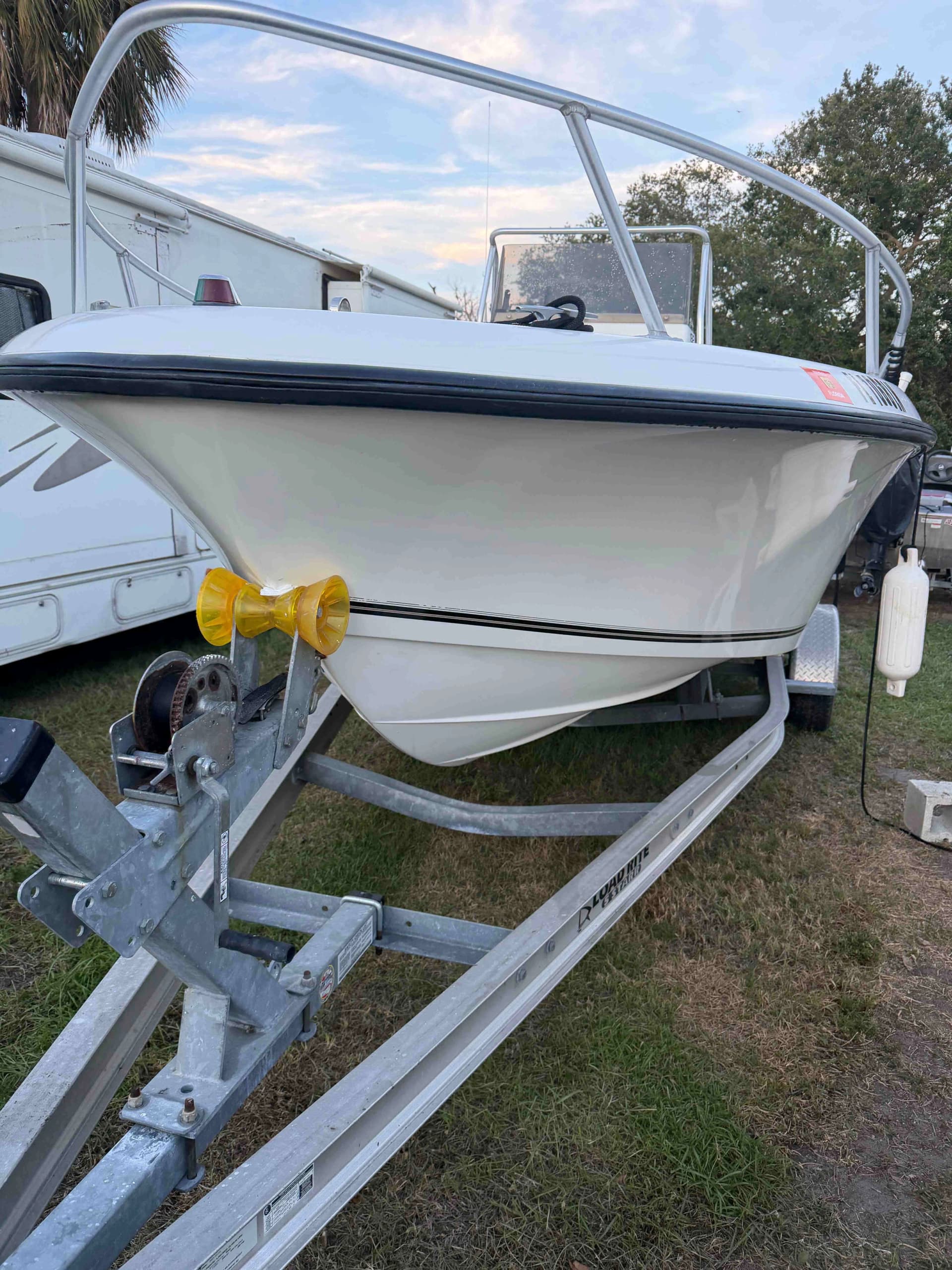
To trailer a boat, match the loaded boat to a trailer and hitch that are rated for that weight, set tongue weight so the trailer does not sway, tie the bow and the transom independently, then check lights, chains, and tires before you roll. Launch by backing in only as far as the bunks or rollers need, with the bow strap still on until the boat is floating. Retrieve in reverse: float on, winch to the bow stop, then strap the transom before you pull out.
This is the road-and-ramp sequence. It is not a towing-capacity guess for a truck you have not checked.
Difficulty: Moderate. First time with a helper. Time: 20–40 minutes to load and secure at the house. 10–20 minutes at the ramp if the lane is clear. Best for: Trailable runabouts, skiffs, bay boats, and pontoons on a matching bunk or roller trailer.
Safety
- The lowest rating in the chain wins: tow-vehicle hitch, ball, receiver, trailer GVWR, and tires. If any one is below the loaded weight, do not tow.
- Gasoline is about 6 lb per gallon. A 40-gallon tank adds about 240 lb. Count fuel, batteries, coolers, and the motor in the trailer load.
- Too little tongue weight makes the trailer sway. Too much lifts the front of the truck and dulls steering. Boat trailers often sit in a 5–10% tongue-weight range because the engine is aft. Many other trailers use 10–15%. Use the trailer maker’s number, then measure.
- Safety chains cross under the coupler. The breakaway cable goes to the truck, not to the same hole as a chain if you can avoid it.
- Do not dunk the truck-to-trailer plug. Even sealed trailer lights fail if the connector sits in the lake.
Tools and materials
- Trailer and tow-vehicle owner’s manuals (ratings)
- Hitch ball that matches coupler size (usually 2 in) and is rated at or above the load
- Coupler pin or lock
- Two safety chains, correctly sized, plus the brake breakaway cable if the trailer has brakes
- Winch strap or cable in good condition, plus a separate bow safety chain or cable to the bow eye
- Two transom (stern) tie-down straps, rated webbing, not rope
- Motor support bar if the outboard must travel tilted (large motors)
- Tire gauge and a spare trailer tire that actually fits
- Bearing buddy grease or a note of when hubs were last serviced
- Dielectric grease for the light plug
- Helper at the ramp the first few times
- Wheel chocks
Before the steps: ratings, not vibes
Read four numbers and write them down:
- Tow vehicle max trailer weight and max tongue weight (door sticker and manual)
- Hitch class and ball rating (stamped on the hitch and the ball)
- Trailer GVWR and tire load rating (VIN / certification label on the frame)
- Boat dry weight + motor + battery + estimated fuel and gear
If 4 is over 3, or 3 is over 1 or 2, you do not trailer this boat with this rig. A “it felt fine last summer” is how axles and hitches fail.
How to trailer a boat, step by step
Step 1: Set the boat on the trailer so the hull is supported
Bunks or rollers should carry the hull along the chines and under the engine, not on a single point that oil-cans the bottom. The boat should sit level. The bow eye should reach the bow stop without the winch strap doing all the lifting.
Why: A hull that sits wrong on the trailer sags. BoatUS notes that long-term trailer storage with poor support can permanently distort the hull. The same geometry matters on the highway. Every bump is a flex.
Step 2: Winch to the bow stop, then add a separate bow safety
Crank the winch until the bow is firm against the stop. Then clip a separate chain or cable from the bow eye to the trailer. Do not treat the winch strap as the only bow restraint.
Why: Winch gears and straps fail. BoatUS is blunt: do not rely solely on the winch cable. If the strap parts, the boat walks back and the transom straps get the whole hit, or the boat leaves the trailer.
Step 3: Strap the transom on both sides
Run rated straps from each stern cleat or the transom eyes down to the trailer. Snug them so the hull cannot bounce on the bunks. Recheck after the first miles. Do not crush the gunwale with a strap over a sharp edge. Use a pad.
Why: The stern is where the mass is. An unstrapped transom slams the bunks and can walk the boat aft until the bow hook is the only thing holding it.
Step 4: Set the motor for the road
Follow the engine manual. Many large outboards travel tilted so the skeg does not drag. If you tilt, put the weight on a motor support bar on the trailer, not on the transom alone. Sterndrives: check the drive’s travel position in the manual.
Why: A hanging lower unit is a lever on the transom. USCG Auxiliary trailering notes call out transom stress when a tilted motor has no support bar.
Step 5: Couple the hitch, then chains, then the breakaway, then lights
Drop the coupler onto the ball. Close and pin it. Lift the jack slightly. The truck should rise a little. If the coupler lifts off the ball, it is not locked. Cross the safety chains under the tongue so they would catch the tongue if the ball failed. Attach the breakaway cable. Plug in the lights. Coat the plug with dielectric grease. Test running lights, brake lights, both turn signals, and hazards on truck and trailer.
Why: NHTSA requires trailer taillights, brake lights, side markers, turn signals, and reflectors. A dark trailer on a highway is a citation and a rear-end. Chains that do not cross can let the tongue spear the pavement.
Step 6: Check tires, lugs, bearings, and tongue jack
Set trailer tire pressure to the sidewall (or the trailer plate if it lists a lower number). Torque lugs. Feel the hubs. A hub that is already hot in the driveway was packed wrong or is failing. Retract and lock the tongue jack.
Why: Trailer tires fail more often than truck tires because they sit and then go to highway speed under load. A seized bearing welds itself at 60 mph.
Step 7: Confirm tongue weight before you get on the highway
With the boat loaded as you will tow it, measure tongue weight (tongue-weight scale, or a public scale: truck only, then truck plus trailer, then uncouple and weigh the truck). For many boat trailers you want about 5–10% of the loaded trailer weight on the ball, unless the trailer maker says otherwise. Shift gear or move the axle adjustment (if the trailer allows it) to correct.
Why: Light tongue = sway you cannot steer out of. Heavy tongue = the truck’s front tires get light and stopping gets longer. This is the step people skip and then blame the truck.
Step 8: Drive like the trailer is longer and slower than you think
Add following distance. Brake earlier. Take wide turns so the trailer does not cut the curb. On the highway, if it starts to sway, do not jerk the wheel and do not slam the brakes. Ease off the throttle in a straight line. Stop and recheck straps and tongue weight.
Why: The trailer reacts later than the truck. A panic brake with a light tongue makes the sway worse.
Step 9: Launch without sinking the lights or the truck
At the ramp: straps off the transom, bow winch and bow safety still on, drain plug in, trailer lights unplugged if they are not submersible. Back in until the bunks are deep enough for the boat to float free. Set the truck in park with the brake on. Walk back, undo the bow safety, ease the winch, push off. Do not back the truck exhaust into the water. Do not hold the lane while you load coolers.
Why: Most ramp fights are people who unhook the bow too early or who sit on the pad doing deck work. The boat stays attached until it is actually floating.
Step 10: Retrieve, then rebuild the road setup before you leave the pad
Back in. Winch the bow to the stop. Bow safety on. Pull up only far enough to clear other ramps. Transom straps on. Motor set for the road. Lights plugged in and tested. Drain plug decision: out if you are heading home and want the bilge to drain, in if the boat still holds water you have not pumped. Recheck the coupler pin.
Why: The retrieve is where people drive home with one strap and no lights because “it’s twenty minutes.” Twenty minutes on a state road is enough.
Once you are off the ramp, the hull is still wet with slime and the waterline is starting to bake. How to clean the hull of a boat by yourself covers the driveway wash. If the brown scum line is already etched in, use the dedicated waterline stain and scum method.
Common mistakes
- Winch only, no bow chain, no transom straps. The boat is a passenger, not cargo you hope stays put.
- Guessing tongue weight. If the trailer hunts in the mirror, stop. Measure.
- Dunking the seven-pin plug. That is how you buy a new harness.
- Trailer tires at “whatever the truck uses.” Read the trailer sidewall.
- Loading coolers and a full fuel tank after you already sat on the edge of GVWR.
- Doing the whole tidy-up in the water on the ramp. Pull forward, then strap.
MDE does not tow your boat. After you retrieve, the hull is usually dirty and the waterline is where slime starts. A full boat detailing checklist is the right next read if you are prepping for a season, not just a rinse. If you want the wash and protection done at your location, check packages and book online.
Frequently Asked Questions
How do you trailer a boat step by step?
Match ratings, support the hull, winch plus a separate bow safety, strap the transom, couple hitch then chains then lights, set tongue weight, then launch with the bow still attached until the boat floats.
What tongue weight should a boat trailer have?
Use the trailer manufacturer’s spec. Many boat trailers run about 5–10% of loaded weight because the engine sits aft. Other trailer types often use 10–15%. Too little causes sway.
Do I need transom straps if the winch is tight?
Yes. The winch holds the bow. The straps hold the stern. BoatUS says a heavy stern strap is required or the boat bounces on the trailer.
Should trailer lights go underwater?
Only if they are built for it. Unplug before launch if they are not. Never soak the truck connector.
Can I trailer with the outboard down?
Some small motors can travel down. Many large motors need to tilt, with a support bar so the transom is not the stand. Follow the engine manual.
References
- NHTSA, Towing a Trailer (hitch, tongue weight, required trailer lighting).
- U.S. Coast Guard Auxiliary, Safe Trailering Operations (tongue weight, straps, motor support, light check).
- BoatUS Foundation, Transportation and Trailering (trailer capacity, lights, bunk support, winch vs separate bow line, transom strap).
- Your trailer, hitch, tow-vehicle, and engine owner’s manuals. Those ratings beat any article.
Boat Detailing Near You
AtlantaBaltimoreBirminghamColumbusDallasDenverHuntsvilleIndianapolisJacksonvilleLos AngelesMemphisMinneapolisNew YorkNorfolkOrlandoSan AntonioSan JoseSavannahSeattleTampaTulsaWilmington