
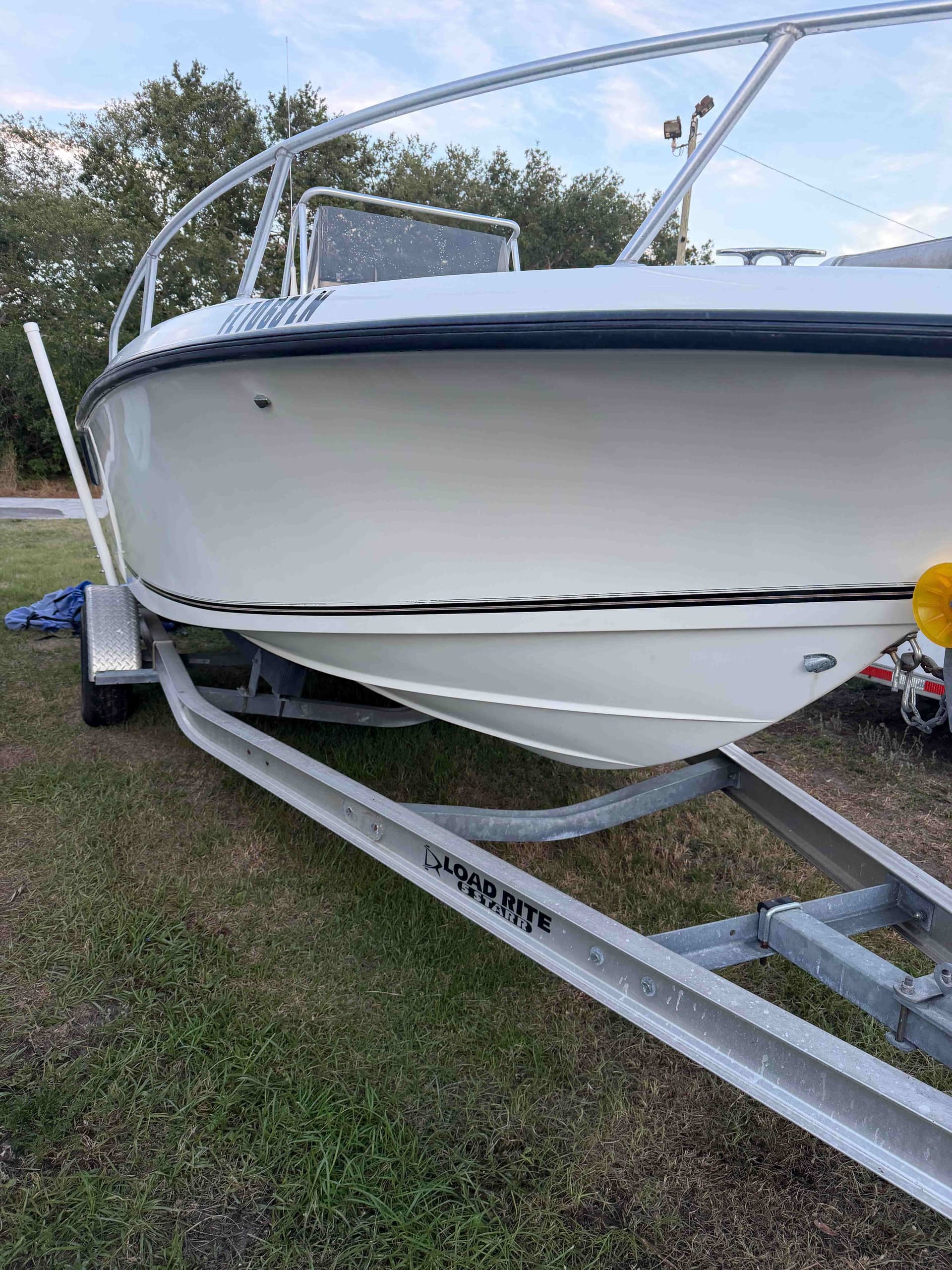
To clean a boat hull yourself, rinse it while the growth is still wet, wash slime with pH-neutral boat soap and a nylon brush, then use a plastic scraper and a marine hull cleaner on barnacle bases and the waterline. Do not use dish soap (it strips wax) and do not use a metal scraper on gel coat. If the gel coat is already chalky, or the bottom paint is coming off in sheets, you have left cleaning and entered restoration.
This is a trailer or lift job you can do at your location. It is not underwater diving on a slip boat, and it is not compounding oxidation. If a hand wipe comes away chalky, stop and read how to remove oxidation from a boat hull.
Difficulty: Easy for slime after a weekend. Moderate for a waterline stain. Hard, and easy to scar, once barnacles have a calcified ring. Time: 30–60 minutes for a 16–20 ft hull with light slime. 2–4 hours if you are popping barnacles. You need: Fresh water, shade if you can get it, and a hull that is out of the water.
Safety
- Acid hull cleaners (oxalic or stronger “hull clean” formulas) need gloves, eye protection, and shoes. Keep them off aluminum, anodes, and skin. Neutralize runoff as the label says. Do not let acid dry on the gel coat.
- Never mix bleach and acid. Never mix bleach and ammonia.
- A pressure washer can cut ablative bottom paint and scar gel coat. If you use one, stay moving, stay well back, and stay under what the paint maker allows. Many bottom-paint techs treat close-range blasting as a paint-removal tool, not a wash.
- On a trailer, chock the wheels. Do not crawl under a boat on jackstands you did not set.
- In the water, scraping a hull is a dive job with different rules. This post assumes the boat is on a trailer, lift, or slings.
Tools and materials
- Garden hose with a nozzle (fresh water)
- pH-neutral boat soap (not dish soap, not household degreaser)
- Two buckets
- Soft or medium nylon brush, long handle for the bottom
- Microfiber or a boat sponge for topsides
- Plastic scraper or plastic putty knife (not steel, not a drywall knife with a burr)
- Marine hull cleaner made for gel coat waterline stains (often oxalic). Read the substrate list. Many eat aluminum.
- Optional: dedicated barnacle-base cleaner for the white rings after you pop the shells
- Baking soda (to neutralize acid if the label calls for it)
- Wet-suit gloves or chemical gloves, eye protection
- Ladder that cannot ding the hull
- Wax or a sealant you already use, for above the waterline after the hull is clean and dry
Not on this list: steel wool, a grill scraper, Comet on gel coat, or a rotary buffer. Those belong to oxidation repair, not a wash.
Know what is on the hull (or you will use the wrong attack)
| What you see | What it is | DIY move |
|---|---|---|
| Slippery green or brown film | Slime / biofilm (can start in days) | Soap, nylon brush, rinse |
| Soft green hair | Algae | Same, more dwell, more brush |
| Hard shells | Barnacles or mussels | Wet plastic scraper, then chemistry on the rings |
| Brown / yellow “mustache” at the waterline | Algae + minerals etched into gel coat | Hull cleaner, small sections. Full method: how to clean boat waterline stains |
| Chalk that wipes off on your hand | Oxidation | Stop. That is compounding, not soap. |
| Colored dust coming off on the brush | Ablative bottom paint working | Soft brush only. You are cleaning paint, not gel coat. |
Catch slime early. Hard growth cements. The longer barnacles sit, the more paint or gel coat you risk when they come off.
How to clean the hull yourself, step by step
Step 1: Rinse the whole hull while it is still wet
If you just pulled the boat, start now. Dry-baked slime and barnacle glue get harder. Soak the bottom and the waterline. Keep the section you are working on wet the entire time.
Why: Barnacle cement and algae slime release cleaner when hydrated. Dry scraping is how you gouge gel coat.
Step 2: Wash slime and algae with boat soap, not dish soap
Mix pH-neutral boat soap as the label says. Work bottom to waterline to topsides so dirty water does not run over a clean stripe. Nylon brush, bow-to-stern strokes on the bottom so you are not grinding one spot. Rinse as you go.
Why: Dish soap is a degreaser. It strips wax and sealant and leaves bare gel coat for the next UV and mineral stain. That is the most common DIY own-goal on a hull.
Step 3: Pop barnacle shells with a plastic scraper, shallow angle
Keep the blade almost flat. Get under the edge of the shell and lift. Do not jab. You want the shell off. You will likely leave a white, calcified base. That is normal. Do not switch to a metal putty knife “just for the stuck ones.” If it will not move wet, soak and use the hull cleaner on the base. On ablative paint, accept that some paint will leave with the shell. That is a paint day later, not a reason to grind harder.
Why: Metal scrapers gouge gel coat and peel more antifouling than the barnacle needed. If the growth needs metal, you are past a driveway clean.
Step 4: Treat the waterline and the white rings in small sections
Apply a marine hull cleaner to a few feet of waterline or to barnacle bases. Dwell only as long as the label says. Scrub with a nylon brush. Rinse thoroughly. Do not let acid dry into a map of dull spots. Keep it off anodes, outdrives, and bare aluminum unless the product says it is safe there.
Why: The “river mustache” is mineral + organic stain in the gel coat. Soap will not break it. Acid will, and it will also stain what you drip it on. For dwell times, pads, and what fails on aluminum, use the longer waterline stain guide. This page stays on the whole-hull sequence.
Step 5: Do the running gear
Prop, shaft, trim tabs, and the lower unit pick up the same slime and a surprising number of barnacles. A little growth on a prop is a real speed and fuel hit. Plastic scraper and soap here too. Do not lever against the seal faces. Check the anode. If it is mostly gone, replace it. That is maintenance, not cosmetic.
Why: People wash what they can see from the dock and leave a bearded prop. The boat then “feels slow” all season.
Step 6: Rinse salt and cleaner off, then dry the topsides
Salt left to dry is the next stain. Fresh water until it sheets clean. Dry metal and the windshield so you do not get spots. Above the waterline, a coat of the wax or sealant you already use buys you time. Do not wax over a bottom-paint zone. Do not ceramic a hull you just acid-washed until the surface is neutralized, rinsed, and the coating maker says the pH is safe.
Why: A clean, unwaxed topside oxidizes faster. A waxed bottom paint stops working as designed. If you are choosing a longer film than wax, boat ceramic coating vs wax is the comparison. Do not coat chalk. Compound first.
Step 7: Stop if you hit chalk, cracks, or paint failure
If a handprint is white, the gel coat is oxidized. More soap will not bring the gloss back. That is a compound and polish job, then protection. If bottom paint is flaking to gel coat, you need paint work, not a stronger acid. If you can see fiberglass print-through or cracks at the waterline, stop scraping.
Why: The specificity test: a car-wash method on a chalked hull is the wrong trade. You would be sanding clear coat with dish soap. Same mistake, different surface.
How often to clean the hull
- Trailer boat that lives dry: rinse after every salt or dirty-fresh outing. A soap wash when the waterline shows.
- Boat that sits in the water: slime in days, soft growth in weeks, hard growth in a month or two in warm water. An in-water brush service is a different job than this post.
- After you haul for the season: clean before the growth dries on. Then winterize the boat.
Common mistakes
- Dawn-and-done. You stripped the wax. The hull will stain faster next month.
- Metal scraper “just this once.” The gouge is permanent. Fill is a gel-coat repair.
- Acid on the whole hull, then lunch. Dried cleaner etches.
- Pressure washer on ablative paint at two feet. You just removed next season’s paint.
- Calling oxidation a dirt problem. Chalk is dead gel coat. It needs polish, not a second soap pass.
- Ignoring the prop.
If the hull is oxidized, the waterline is etched, or you do not want to spend a Saturday on your back under a trailer, a mobile detailer can wash, decontaminate, and restore gel coat at your location. The complete boat detailing guide shows what that visit includes. Check packages and book online when the job has moved past soap and a plastic scraper.
Frequently Asked Questions
How do you clean a boat hull yourself?
Rinse wet, wash slime with pH-neutral boat soap and a nylon brush, pop barnacles with a plastic scraper, then use a marine hull cleaner on the waterline and the leftover rings. Rinse salt and acid off completely.
Can I use dish soap on a boat hull?
No. It strips wax and sealant and leaves gel coat open to UV and stains. Use boat soap.
How do I get barnacles off without scratching the hull?
Keep them wet. Use a plastic scraper at a shallow angle. Dissolve the white base with a hull cleaner. Skip metal.
Will this remove oxidation?
No. Oxidation is a dull, chalky gel coat. That takes compounding and polish. See boat oxidation removal. Cleaning first is still required so you are not grinding dirt into the surface.
Can I clean the hull in the slip?
Light slime, maybe, with a brush from a dock, where it is legal. Heavy scraping in the water is a dive/haul-out job and often restricted at marinas because of paint and debris.
References
- BoatUS and typical manufacturer wash guidance: use boat soap, not household degreasers, on waxed gel coat.
- Standard marine practice on fouling stages (slime, then algae, then hard growth) and plastic-only scrapers on gel coat and antifouling.
- Product labels on oxalic/acid hull cleaners for dwell time and metal restrictions. Those labels win on chemistry.
- Your bottom-paint technical data sheet if the hull is painted. Ablative paint has different rules than bare gel coat.
Boat Detailing Near You
AtlantaBaltimoreBirminghamColumbusDallasDenverHuntsvilleIndianapolisJacksonvilleLos AngelesMemphisMinneapolisNew YorkNorfolkOrlandoSan AntonioSan JoseSavannahSeattleTampaTulsaWilmington