
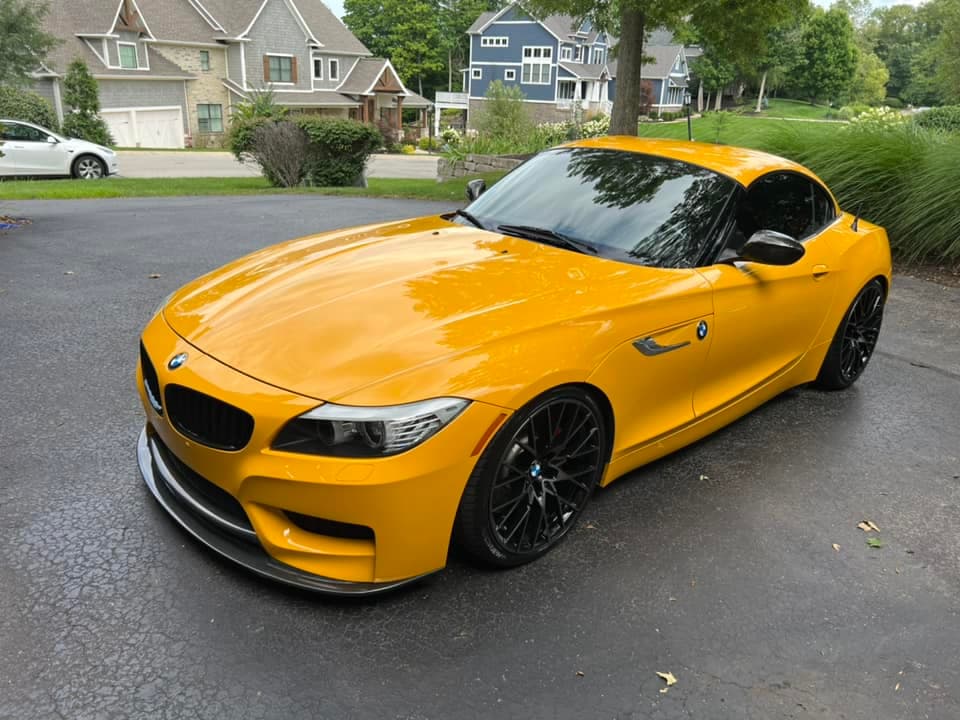
A pro exterior detail isn't a longer version of a home car wash. It's a specific sequence designed to handle different contamination layers in the right order, prepare the paint for protection, and produce a result that lasts longer than any random combination of steps would. The six-stage process below is the standard professional workflow. It applies whether you're detailing a Civic or a Suburban, doing it monthly or quarterly. The stages don't change. What changes between vehicles is product selection and time spent per stage.
Stage 1: Foam pre-soak and rinse
Before any physical contact with the paint, the goal is to remove as much loose surface contamination as possible.
The process:
Park in shade or under cover (direct sunlight dries products too fast) Rinse the vehicle from top to bottom with clean water Apply foam through a foam cannon attached to a pressure washer, or via foam gun on a garden hose Let the foam dwell 3–5 minutes — long enough to break down road film, not so long it dries Rinse thoroughly from top to bottom
Why this stage matters: every particle that comes off in pre-soak is a particle that doesn't get dragged across the paint by your wash mitt. This stage alone prevents most wash-induced scratching. The foam doesn't need to be the snow-foam aesthetic of car detailing videos. It needs to be a soapy alkaline-neutral pre-wash chemical that lifts and floats dirt off the paint surface.
Stage 2: Two-bucket hand wash
Physical contact begins here, and it follows specific procedure to minimize scratching.
The setup:
- Two buckets, both with grit guards in the bottom
- One bucket filled with pH-neutral car shampoo and water
- One bucket filled with clean rinse water only
A clean, soft microfiber wash mitt (not the same one used on wheels) Optionally, separate mitts for upper and lower body panels
The process:
Start at the top of the vehicle (roof, then glass, then upper panels) Wash one panel at a time in straight lines, top to bottom After each panel, rinse the mitt in the rinse bucket Agitate against the grit guard to release embedded debris Reload soap from the wash bucket Move to the next panel End with the lower body panels and the very lowest sections Rinse the entire vehicle thoroughly
Why this stage matters: top-to-bottom washing prevents the dirtiest debris (lower panels, wheel arches) from contaminating the mitt before it touches the cleanest surfaces (roof, hood). The two-bucket method prevents you from re-applying contamination during washing. Wheels and tires are typically washed before or after the body wash, with separate brushes, mitts, and cleaners — never with the body wash equipment.
Stage 3: Decontamination (iron remover + clay)
After the wash removes loose dirt, decontamination removes bonded contaminants that washing can't touch. The iron decon step:
- Spray iron remover on slightly damp paint
- Watch for color change (purple/red where iron is present)
- Dwell 3–7 minutes
- Rinse thoroughly
The clay step:
- Lubricate the panel with clay lube or quick detail spray
- Glide clay across the panel with light pressure
- Fold clay to expose fresh face when surface gets contaminated
- Continue until clay slides silently across the panel
- Repeat on all painted surfaces
Why this stage matters: every protective product (wax, sealant, ceramic) bonds best to a smooth, decontaminated surface. Skipping decon doesn't just mean missing the contamination removal — it means the protection layer you apply afterward will bond weakly and fail early. Light decon can be skipped on garage-kept cars or recently-detailed vehicles that pass the bag test. Daily drivers, outdoor parkers, and any vehicle 6+ months from its last decon should always include this step.
Stage 4: Drying
A proper dry is faster, safer, and more thorough than air-drying or hot-day evaporation.
Tools:
- Large microfiber drying towel (waffle weave or twisted-pile microfiber)
Optionally, a forced-air car dryer for hidden water in panel gaps and emblems A separate microfiber for glass
The process:
- Start at the top and work down
- Pat the towel onto the surface rather than dragging it
- Use one direction of motion rather than circular
- Flip and refold the towel as it becomes saturated
Pay attention to mirrors, badges, and panel gaps where water hides
Why this stage matters: water spots are minerals deposited as water dries on hot paint. Drying quickly with clean microfiber prevents this. Air-drying — especially in sun — bakes mineral deposits into the clear coat where they require correction to remove. A forced-air dryer for crevices is the difference between a good detail and a great one. Water trapped in mirror gaps, badge edges, and panel seams will weep out later and leave streaks on otherwise clean panels.
Stage 5: Protection (wax, sealant, or spray coating)
With the paint clean, decontaminated, and dry, protection goes on.
Options and method:
Carnauba wax — apply thin, even layer with foam applicator; let haze; buff off with clean microfiber. Work panel by panel. Synthetic sealant — apply by hand or with DA polisher on finishing pad; allow cure time (varies by product); buff off with clean microfiber. Work panel by panel. Spray sealant / ceramic spray — spray onto cool, dry panel; spread with microfiber; flip to clean side and buff. Easiest method, good for maintenance refreshes. Why this stage matters: this is the protection layer that determines how the paint looks and how long it stays protected before the next detail. The product selection matters less than proper application — a quality sealant applied poorly underperforms a basic wax applied well.
Stage 6: Tires, trim, and finishing details
The visual difference between a wash and a detail is mostly here.
The work:
- Clean tires with dedicated tire cleaner if not done earlier
- Apply tire dressing (water-based or solvent-based, depending on look)
- Treat plastic trim with dedicated trim restorer
- Clean glass with dedicated glass cleaner and microfiber
- Treat any chrome or polished metal
- Clean and dress any rubber seals
Why this stage matters: faded trim, gray tires, and streaky glass make a perfectly waxed car still look mediocre. Five minutes per element makes the difference between "clean" and "detailed."
Why the order doesn't change
Each stage prepares the surface for the next:
Pre-soak removes loose contamination so wash doesn't push it across paint Wash removes the bulk of surface dirt Decon removes bonded contamination wash couldn't touch Dry prepares the surface for product bonding Protection seals the prepared paint Detailing finishes the appearance
Rearrange any stage and the work degrades. Skip a stage and the result degrades faster. The order is the order because each step builds on the last.
How long the full process takes
A thorough exterior detail on a standard sedan: 3–4 hours. On an SUV or truck: 4–5 hours. On a large truck, RV, or van: 5–7 hours. This is professional pace using proper equipment. DIY attempts often take longer for less complete results. For owners doing this themselves, breaking the work across two sessions (decon and wash on day one, protection and finishing on day two) is realistic. For weekly maintenance washes, only stages 1, 2, 4, and a quick spray sealant from stage 5 are needed — typically 45–60 minutes.
Book mobile exterior detailing — we follow this six-stage process at your location.
When you are ready, browse detailing packages or request a quote. Learn more at Mobile Detailing Expert.
Exterior Detailing Near You
AtlantaBaltimoreBirminghamColumbusDallasDenverHuntsvilleIndianapolisJacksonvilleLos AngelesMemphisMinneapolisNew YorkNorfolkOrlandoSan AntonioSan JoseSavannahSeattleTampaTulsaWilmington